What is AIOps?
AIOps (Artificial Intelligence for IT Operations) combines artificial intelligence, machine learning, automation, and large-scale data analytics to improve operational efficiency.
Rather than relying solely on manual investigations and predefined rules, AIOps platforms can analyze massive amounts of operational data in real time to identify anomalies, correlate events, detect patterns, and assist engineers in decision-making.
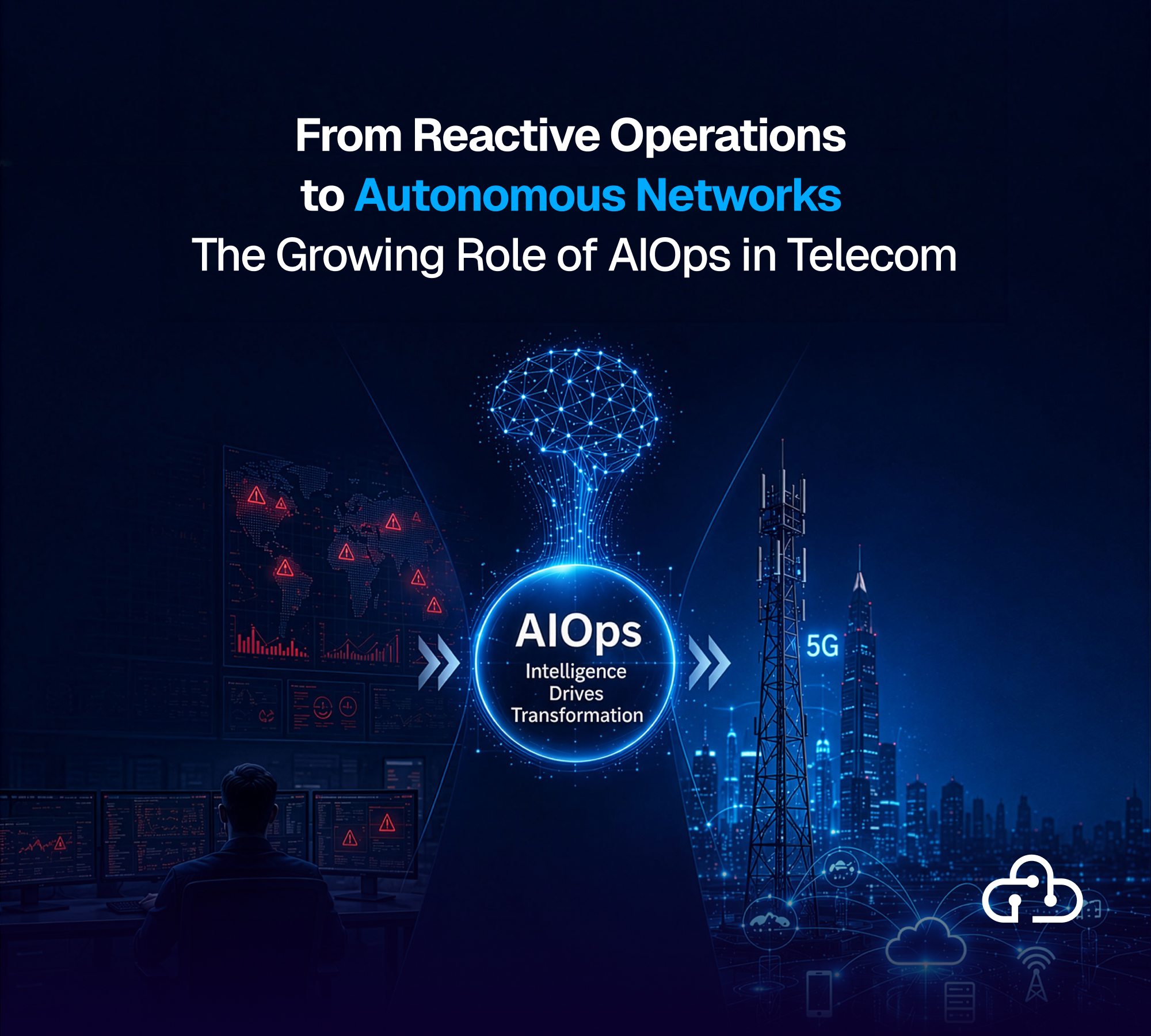
The objective is not simply to automate tasks, but to help operations teams move from reactive troubleshooting to proactive and predictive operations.
Why Traditional Operations Are Reaching Their Limits
Modern telecom networks generate data from multiple domains:
- Radio Access Networks (RAN)
- 4G and 5G Core Networks
- IMS and Voice Services
- Transport and IP Networks
- Cloud Infrastructure and Kubernetes Platforms
- OSS, BSS, and Service Layers
Each domain produces alarms, KPIs, logs, traces, and performance metrics. As networks become more distributed and multi-vendor, identifying the root cause of an issue often requires engineers to manually investigate information spread across several systems.
This process can be time-consuming and can increase Mean Time to Resolution (MTTR), operational costs, and service impact.
AIOps helps address this challenge by providing a unified intelligence layer capable of analyzing data across multiple domains simultaneously.
Key AIOps Use Cases in Telecom
Intelligent Fault Detection
AI models can continuously monitor network behavior and identify anomalies that may indicate service degradation, configuration errors, or infrastructure issues before they impact customers.
Instead of waiting for incidents to occur, operators gain earlier visibility into potential problems.
AI-Powered Root Cause Analysis
One of the most promising applications of AIOps is Root Cause Analysis (RCA).
Rather than manually reviewing thousands of logs, traces, and alarms, AI can correlate events across network domains and highlight the most likely source of an issue.
This allows engineering teams to troubleshoot faster and focus their efforts on remediation rather than investigation.
Automated Testing and Validation
As networks evolve through continuous software releases and configuration updates, testing becomes increasingly important.
AI can assist teams by:
- Generating test scenarios from requirements
- Analyzing test results automatically
- Detecting anomalies during validation
- Identifying potential risks before deployment
By combining testing and AIOps capabilities, operators can reduce deployment risks while accelerating service rollout.
Predictive Operations
Historical network data can be used to identify trends and predict future failures.
This enables operators to take preventive actions before incidents affect customers, reducing downtime and improving service reliability.
The Building Blocks of Autonomous Networks
The telecom industry increasingly views autonomous networks as a strategic objective.
Achieving this vision requires more than network automation. It requires intelligence capable of understanding network behavior, validating changes, identifying issues, and recommending corrective actions.
AIOps provides many of the foundational capabilities required for this transition, including:
- Data correlation across multiple domains
- Automated analysis and validation
- AI-assisted decision making
- Continuous monitoring and optimization
- Closed-loop automation
As these capabilities mature, operators can progressively reduce manual intervention while improving operational efficiency.
Challenges to Adoption
Despite growing interest, implementing AIOps remains a journey.
Common challenges include:
- Data silos across network domains
- Legacy operational systems
- Limited AI and data engineering skills
- Multi-vendor complexity
- Data quality and governance requirements
Successfully adopting AIOps requires both technology and workforce readiness. Organizations must invest in modern platforms, operational processes, and skills development to maximize the value of AI-driven operations.
Looking Ahead
The future of telecom operations will be increasingly data-driven, automated, and intelligent.
As network complexity continues to grow, operators will need new approaches to testing, validation, troubleshooting, and operational management. AIOps offers a practical path toward achieving these objectives by helping teams reduce operational complexity, accelerate root cause analysis, improve network reliability, and build the foundations for autonomous networks.
Organizations that begin integrating AI into their operational workflows today will be better positioned to manage the networks of tomorrow.