

There is a dangerous assumption woven into the fabric of most enterprise technology programmes today: that automation and autonomy are the same thing. They are not.
Automation executes a predetermined instruction reliably. Autonomy perceives a situation, reasons about it in context, decides on a course of action, executes, observes the result, and learns. Automation is a tool. Autonomy is a capability and the difference between the two is becoming the defining competitive variable of the decade ahead.
Communications Service Providers understand this acutely. Managing networks that carry millions of simultaneous sessions across disaggregated, heterogeneous infrastructure, they sit at the exact point where the gap between automation and autonomy becomes operationally critical. But they are not alone. Every large enterprise; financial services, healthcare, logistics, manufacturing, retail faces its own version of the same reckoning: the world generates more signal than human operators can process, more events than runbooks can address, and more complexity than legacy tooling was ever designed to navigate.
The enterprises building durable competitive advantage right now are not doing it by buying more tools. They are doing it by building capabilities. Here is what those capabilities look like.
Capability One
The Compounding Loop: Agentic Observability for Autonomous Networks
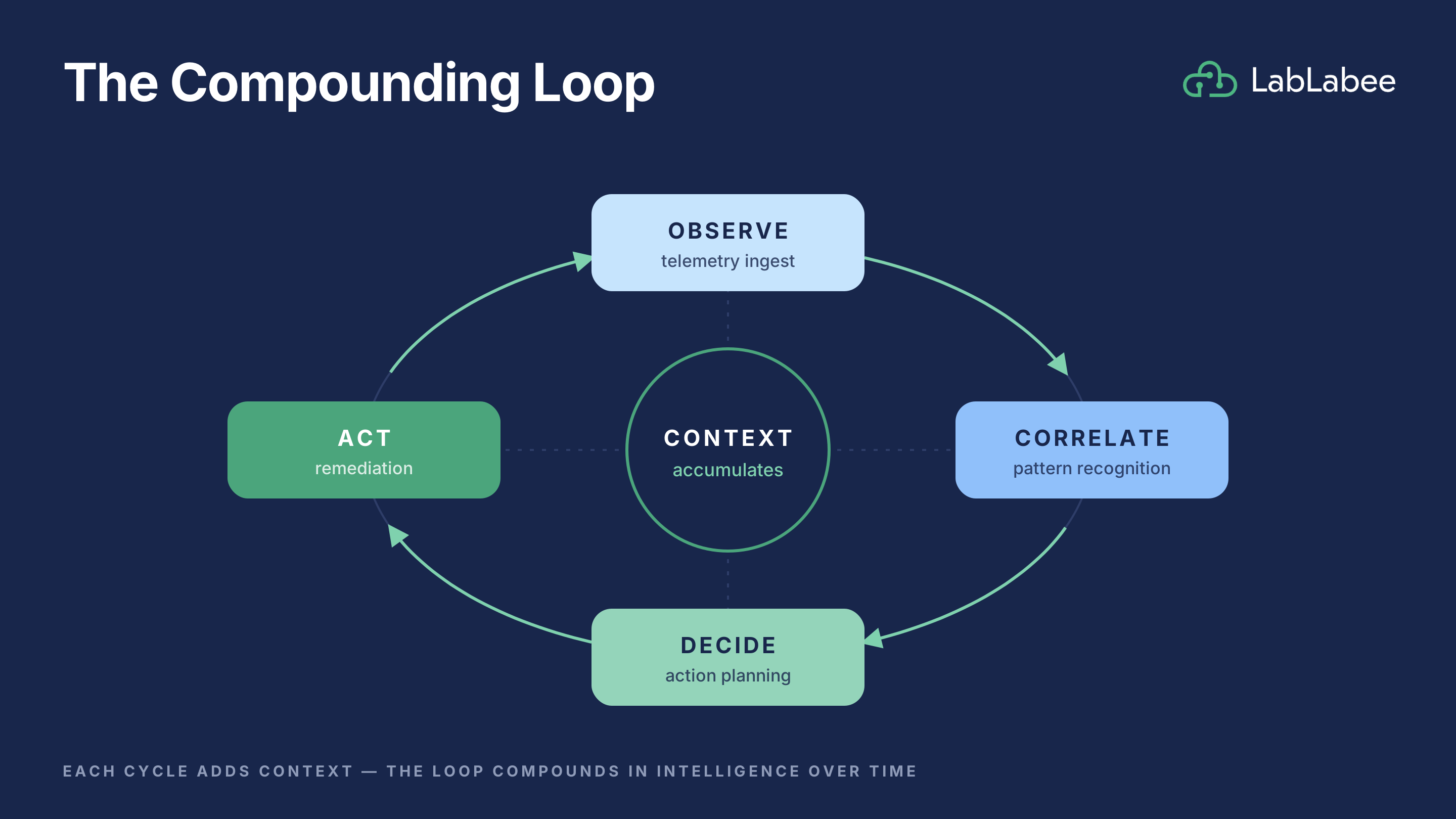
Traditional observability is a rearview mirror. It tells you what happened. At best, it alerts you when a threshold has been breached. But in a complex, dynamic environment whether a CSP’s RAN estate, a bank’s trading infrastructure, or a global retailer’s supply-chain network, the question that matters is not just what happened, but why it happened, what it means, and what should change right now.
Agentic observability changes the model entirely. Instead of dashboards surfacing anomalies for humans to investigate, intelligent agents continuously ingest telemetry, correlate signals across systems, form hypotheses, validate them against historical context, and initiate or recommend remediation, all in a loop that compounds in intelligence over time.
The compounding effect is where the strategic value lives. Each observation cycle makes the next more precise. The agent’s model of what “normal” looks like becomes richer, its detection of genuine deviation becomes sharper, and the distance between event and resolution narrows, not through brute-force processing, but through accumulated context.
For CSPs managing dynamic spectrum allocation, network slicing, and real-time quality-of-service guarantees, this is not a theoretical improvement, it is an operational necessity. The same logic applies to any enterprise operating at a scale and velocity where the signal-to-noise ratio of conventional monitoring tools has become its own problem. The network that learns its own normal, and acts on deviations before they become incidents, is qualitatively different from the network that generates tickets for humans to triage.
Agentic observability is not a better alerting system. It is the nervous system of an autonomous enterprise.
Capability Two
Memory as Infrastructure: Long-Running Agents and Institutional Knowledge
Of all the capabilities that define the autonomous enterprise, the most underestimated is memory.
Every organisation carries institutional knowledge, the accumulated understanding of why things are the way they are, what was tried before, what broke last time, and what the unwritten rules are. In most enterprises today, that knowledge lives in people. When those people leave, retire, or move to different teams, the knowledge leaves with them. What remains is documentation that is out of date, tribal memory that is inaccessible to the next shift, and a recurring cost of relearning.
Long-running agents change this. An agent that persists across a multi-month network rollout carries the full context of every decision made, every anomaly encountered, every parameter tuned, not as a log file that must be searched, but as living working memory that informs every subsequent action. For a CSP managing a nationwide 5G Core migration, this is the difference between an agent that works intelligently from day one and one that requires months of re-familiarisation every time a human operator changes shift. For an enterprise running extended ERP transformation programmes, it is the difference between institutional continuity and constant knowledge reset.
Institutional memory is not a feature of an AI system. It is a strategic moat. The enterprise that builds durable, structured, queryable AI memory builds an organisational advantage that compounds in the same way that compounding loops compound observability.
This reframes how we should think about enterprise AI investment. The question is not only “what can this agent do right now?” but “what will this agent know in twelve months that no competitor’s agent will know?” That question — the question of accumulated organisational intelligence — deserves to sit at the heart of every enterprise AI strategy.
Capability Three
The Cross-Correlation Challenge: Spanning Legacy and New at Scale
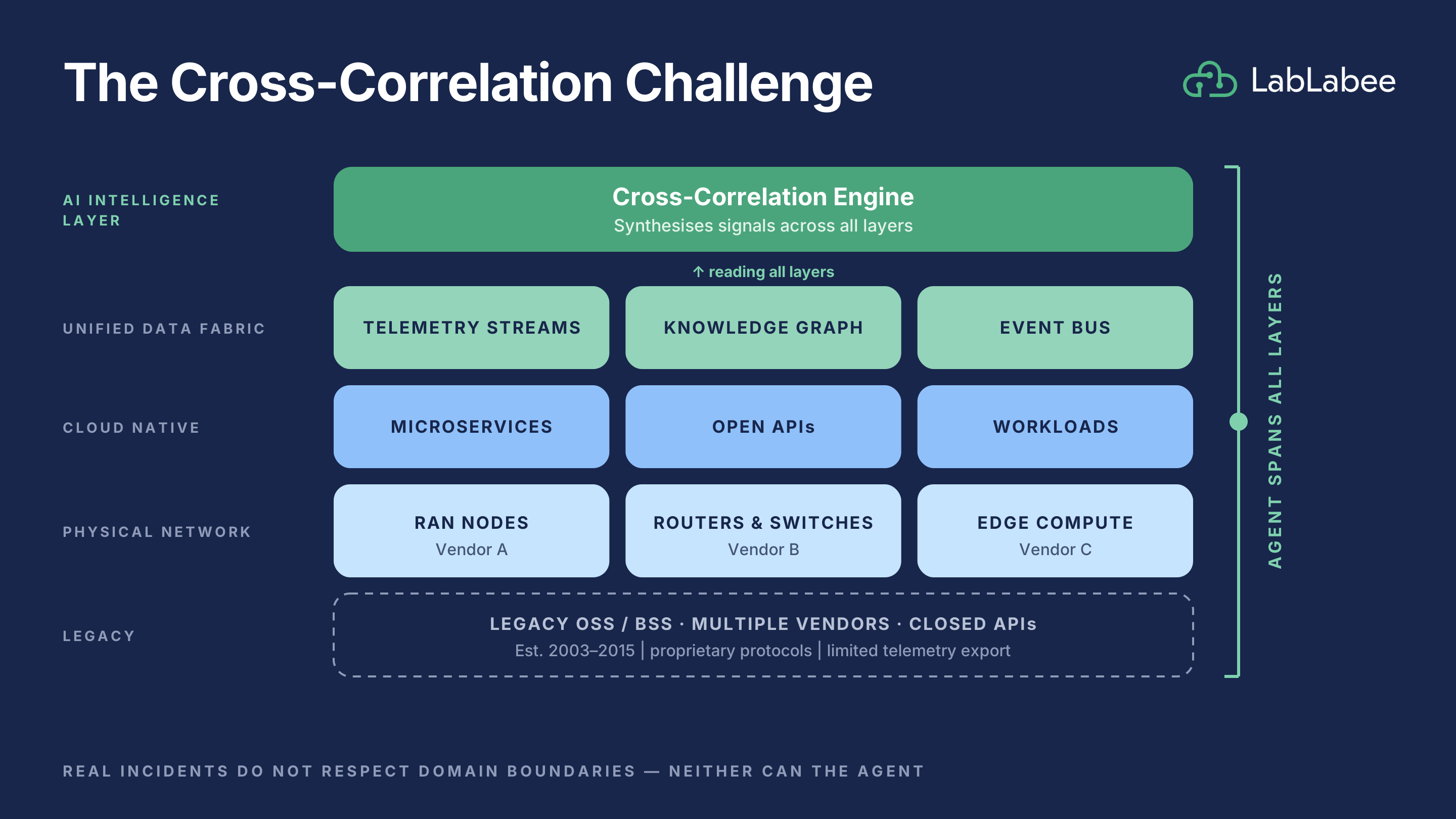
The real world of enterprise technology is not clean. It is a palimpsest, layer upon layer of systems, protocols, and architectures accumulated across decades of technology investment. A typical large enterprise or CSP operates infrastructure spanning equipment from multiple vendors, OSS and BSS platforms of varying vintage, cloud-native workloads running alongside physical infrastructure, and data models that have never been fully rationalised because rationalising them has always been “next year’s project.”
This is the environment in which autonomous agents must operate. And the cross-correlation challenge, the ability to synthesise signal across these disparate environments and surface genuinely meaningful insight, is one of the hardest problems in applied AI.
It is easy to build an AI system that correlates data within a single domain: all your cloud logs, or all your network telemetry from a single vendor. It is significantly harder to build one that understands the relationship between a latency spike on a ten-year-old network element, a configuration change pushed through a modern cloud-native orchestration layer, and an uptick in customer complaints surfacing through a CRM that no longer receives active development investment. Yet that is precisely the kind of correlation that matters in practice because real incidents do not respect domain boundaries.
The enterprises succeeding at this are approaching it as a data and semantic problem before it is an AI problem. Unified observability fabrics, knowledge graph approaches to configuration state, and careful agent design that encodes domain knowledge about how legacy systems fail, these are the foundations on which meaningful cross-correlation is built. Agents that can reason across the full stack, from the legacy to the bleeding edge, are not just technically impressive. They are operationally transformative.
The Trust Foundation
Autonomy Does Not Mean Unsupervised: Guardrails, Human Judgment, and the Discipline of Evals
The word “autonomy” makes some people nervous. That reaction is not irrational, it deserves to be heard. Autonomy without accountability is not a capability. It is a liability. But the choice on offer is not between autonomous systems and accountable ones. It is between autonomous systems that are thoughtfully governed and those that are not.
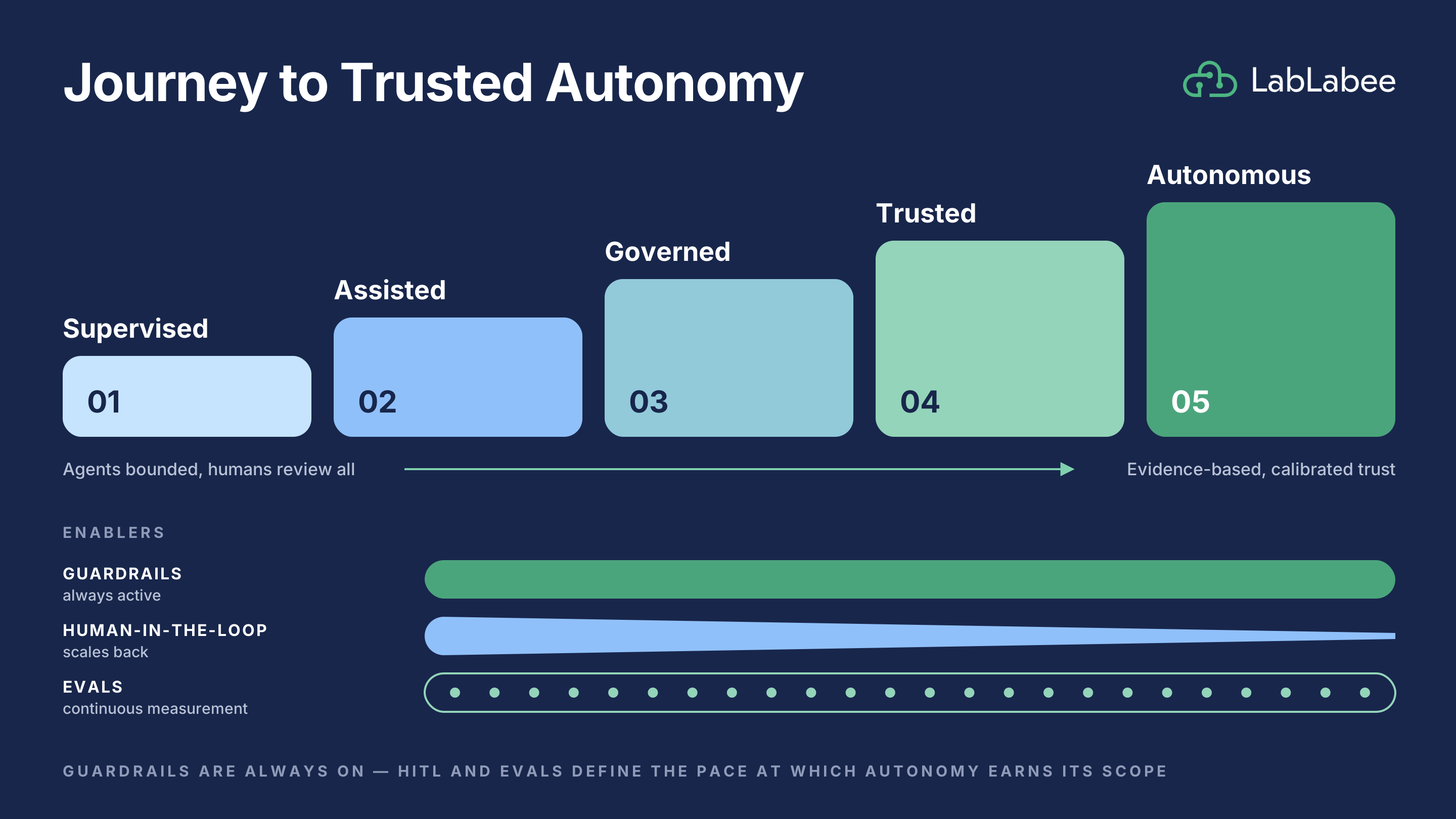
Guardrails are organisational policy made executable. They are the defined envelope of acceptable action, the bounds within which an agent can move with speed and confidence, and beyond which it must pause and escalate. A well-designed guardrail does not slow an autonomous system down. It focuses it. For a CSP, this might mean an agent that can autonomously adjust traffic routing within defined performance parameters, but must escalate decisions that touch contracted SLAs or regulated network segments. The guardrail is not the enemy of autonomy. It is the condition under which autonomy becomes trustworthy enough to deploy at scale.
A guardrail does not tell an agent what it cannot do. It tells an agent what it is authorised to do and that clarity is the foundation of fast, confident autonomous action.
Human-in-the-loop (HITL) design is the deliberate design of escalation pathways that engage human judgment at precisely the moments where human judgment adds genuine value. The most effective autonomous systems today are not fully autonomous, they operate with confidence within their domain of competence and surface genuine exceptions to human decision-makers. An agent that knows the boundary of its own competence, and is honest about it, is not a weaker agent. It is a more trustworthy one.
Evals are the ongoing, systematic measurement of whether agents are behaving as intended. Well-designed evals catch problems before they become incidents. They build the evidence base that allows an organisation to extend autonomous scope over time, not as an act of faith, but as a calibrated decision grounded in observed, measured performance. They are how you earn the right to reduce oversight. Without evals, autonomous systems are black boxes. With them, they are accountable systems that can be trusted, challenged, refined, and improved.
Together, these define a model of progressive autonomy: begin tightly bounded, evaluate rigorously from day one, and extend scope as observed performance earns it. This is the responsible path to enterprise-grade autonomy. And it is the one that actually works in production.
A Gentle Observation
Let’s Move Forward
It would be remiss not to acknowledge something that sits in the room at most enterprise AI conversations: some of the most significant barriers to autonomy are not technical. They are commercial and architectural; built, sometimes deliberately, into the foundations of existing vendor relationships.
For years, complexity has been somebody’s business model. Proprietary data formats, closed APIs, integrations that only work cleanly within a single vendor’s ecosystem, and support structures that reward breadth of deployment over quality of outcome these are not accidents. They are architecture. And they create a gravitational pull that slows the transition to genuinely autonomous, open, composable enterprise systems.
The good news is that the market is voting clearly. Enterprises that have built real autonomous capability have almost universally done so by placing composability and openness at the centre of their architecture choosing platforms and partners that extend their options rather than constrain them. The ones that move fastest are not the ones with the most legacy tools. They are the ones who decided that their enterprise capability stack should be theirs; portable, extensible, and not dependent on any single vendor’s roadmap decisions.
The technology that matters for the autonomous enterprise is available. The path forward is open. The only meaningful question is whether the organisations that need to lead are willing to choose it.
Capability Five
The AI-Native Organisation: Workforce Evolution as Strategy
Every serious conversation about enterprise autonomy eventually arrives at the same place: people. Not because people are the problem, but because people are, and will remain, the point.
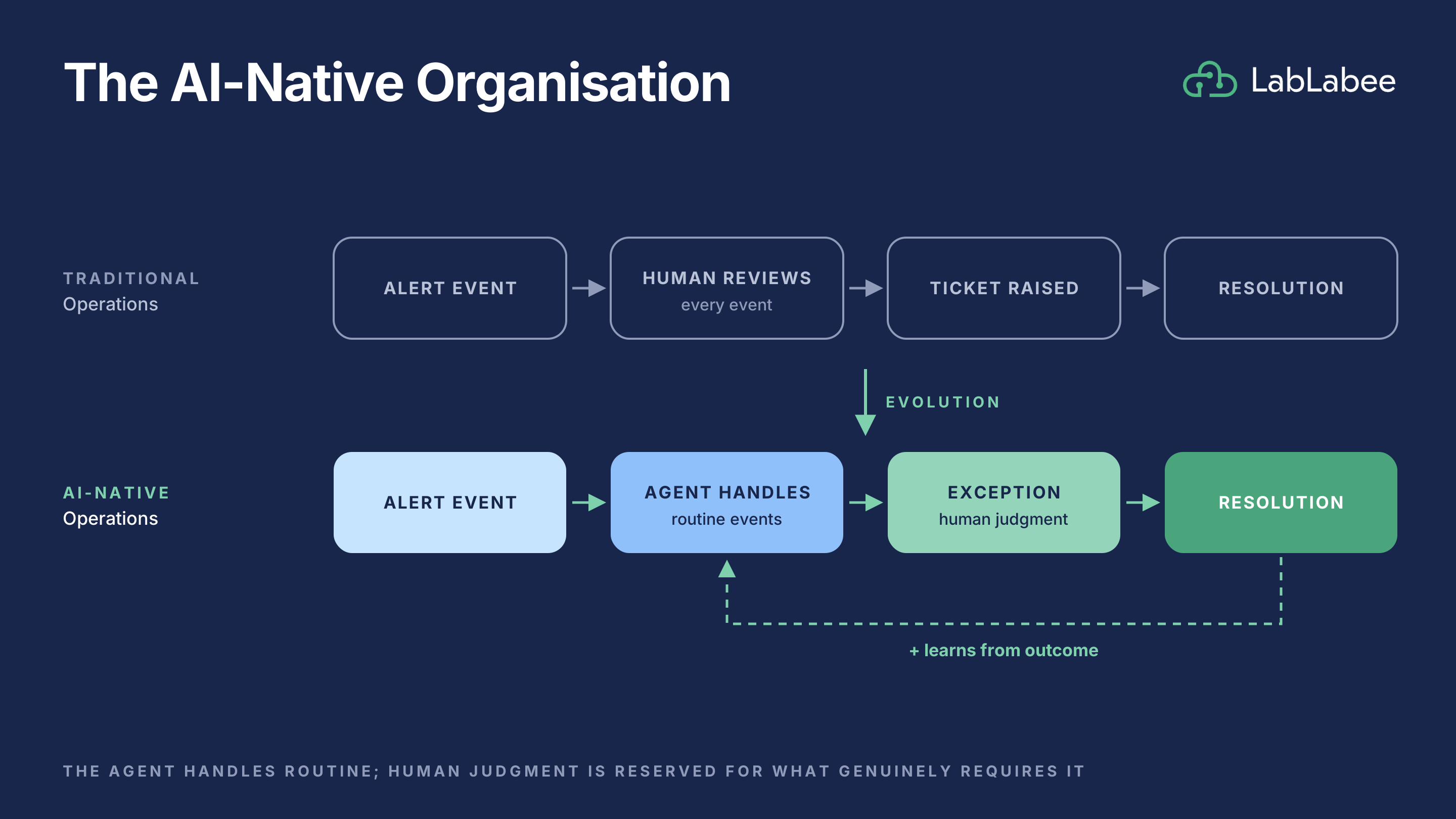
The autonomous enterprise does not replace its workforce. It transforms what that workforce is asked to do. When agents handle continuous monitoring, routine correlation, incident triage, and first-line remediation, human expertise is freed to do what human expertise is actually for: exercising judgement in genuinely novel situations, designing the systems that agents will operate within, setting the organisational intent that agents will pursue, and interrogating outcomes that require ethical or strategic deliberation beyond what any model can provide.
This is not a soft observation. It is an organisational design imperative. The CSPs and enterprises winning at AI-native operations are redesigning job families, retraining workforce cohorts, and rethinking the skills that sit at the centre of their talent strategy. The network operations engineer of five years ago whose primary job was to watch dashboards and action tickets is evolving into an orchestration specialist — someone who designs agent workflows, evaluates agent performance, and escalates the exceptions that require human judgement.
An AI-native organisation is not one where AI has replaced humans. It is one where humans have been liberated to operate at the level of complexity and judgement that AI cannot yet reach — and where that level rises continuously as the AI improves.
Getting there requires deliberate investment in workforce evolution, not as an HR initiative bolted onto an AI programme, but as the strategic core of the autonomy roadmap itself. Organisations that treat workforce transformation as a consequence of AI deployment, rather than as a precondition of it, consistently underperform those that run both tracks in parallel. The technology changes what is possible. The people determine whether that possibility becomes reality.
What We Are Seeing
Applied AI and the Autonomy Imperative
Across sectors and the signal is unmistakable in conversations with CSPs, financial institutions, logistics operators, and large-scale manufacturers alike there is a shift in how enterprise leaders are framing their AI investment. The frame is no longer primarily about efficiency. It is about capability.
Applied AI, in this context, means something specific: AI that is embedded in the operational fabric of the enterprise, not residing in proof-of-concept sandboxes. It means agents that run in production, that hold institutional memory, that observe and act in real time, and that are governed thoughtfully enough that the organisation trusts them with consequential decisions. The keenness around this approach among enterprise and CSP leadership teams is real and it is driven by a recognition that workforce evolution and AI deployment are not parallel tracks. They are the same track.
The customers who understand this most clearly share a common conviction: autonomy is not a technology outcome. It is an organisational one. You do not achieve an autonomous enterprise by deploying autonomous technology. You achieve it by building an organisation its people, processes, memory, and culture that is capable of operating autonomously. The technology enables it. The organisation must be built to receive it.
CSPs, in particular, occupy a uniquely powerful position in this landscape. They are simultaneously building the autonomous infrastructure of the enterprise world the networks, the edge compute capacity, the low-latency connectivity that autonomous systems depend on and operating their own highly complex enterprises in which the very same principles must be applied. They have every incentive, and every opportunity, to lead.
In Closing
Autonomy Is Not a Destination. It Is a Practice.
The autonomous enterprise will not arrive as a product launch. It will be built, incrementally, through choices about architecture, about data, about people, about memory, about which capabilities to develop rather than which tools to procure.
The compounding loops of agentic observability, the institutional memory carried by long-running agents, the hard work of cross-correlation across heterogeneous environments, the governance architecture of guardrails and human-in-the-loop design, the ongoing discipline of evals, and the careful evolution of the workforce toward AI-native ways of working, none of these are easy. But they are, collectively, the shape of what sustainable enterprise advantage looks like in the years ahead. And notably: they are also the shape of autonomous systems that people can actually trust.
The question for every enterprise leader is not whether this transition is coming. It is whether your organisation is building the capabilities now that will define your position when it arrives in full force. The gap between the enterprises that are genuinely building toward autonomy and those still treating AI as a productivity tool is already visible. In two to three years, it will be decisive.
The nervous system is there to be built. The memory is there to be accumulated. The workforce is there to be evolved. The only real variable is intent and the courage to act on it before the window narrows.