
Telco Cloud Kubernetes Security Project

.svg)

About The Lab
Prerequisites


Audiences
Lab Architecture
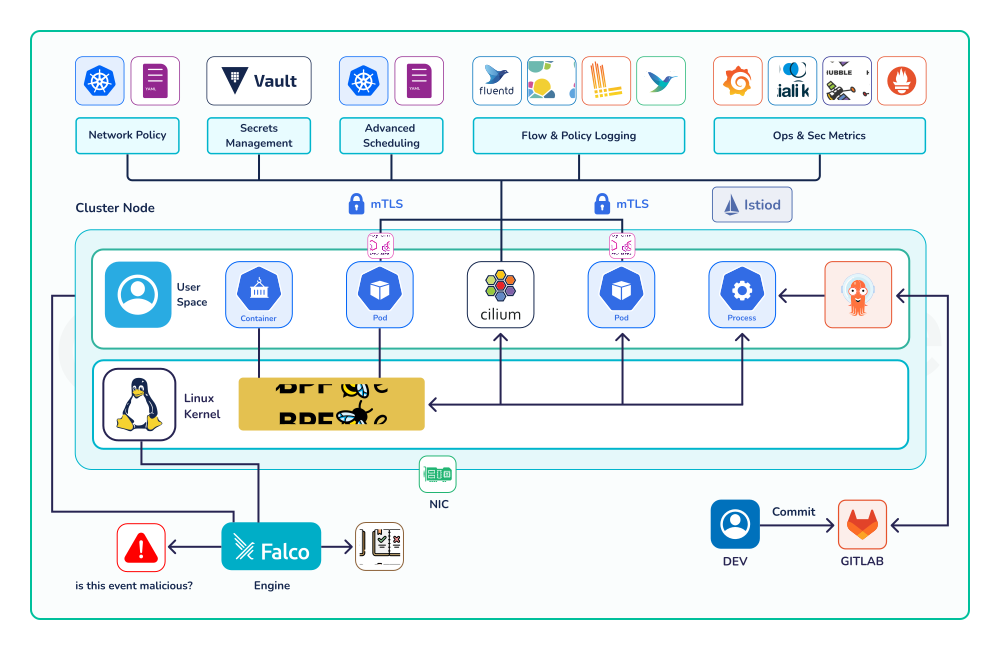
The lab provides a hands-on environment based on a kubeadm-initialized Kubernetes cluster where users deploy and manage containerized 5G network functions across multiple namespaces (RAN, control plane, and user plane). The architecture integrates key components such as Calico and Multus for networking, NGINX Ingress and Cert-Manager for secure traffic management, Harbor for image registry and scanning, and Keycloak for authentication.
Users will configure RBAC, network policies, and secure workloads while interacting with core Kubernetes components like etcd, enabling a realistic simulation of Telco Cloud orchestration, security, and automation scenarios.
Why this Lab ?
This lab provides hands-on experience in building and operating a Kubernetes cluster initialized with kubeadm to simulate a Telco Cloud environment. Participants will deploy containerized 5G network functions (CNFs) across different network planes (RAN, control, and user), configure networking with Calico and Multus, and implement traffic management using network policies.
The lab also covers essential security and operations practices, including TLS-secured ingress, RBAC, ConfigMaps and Secrets management, policy enforcement (OPA Gatekeeper, Kyverno), system hardening (AppArmor), and image scanning with Harbor.
By working through these scenarios, participants develop practical skills in orchestration, network segmentation, and securing cloud-native 5G infrastructures.
Lab Objectives
- Set up a Kubernetes cluster using kubeadm.
- Deploy and manage containerized 5G network functions (CNFs).
- Organize workloads across RAN, control plane, and user plane namespaces.
- Configure networking using Calico and Multus for multi-interface communication.
- Implement network policies for traffic control and segmentation.
- Expose services securely using NGINX Ingress and TLS with Cert-Manager.
- Apply RBAC and resource quotas for access control and resource management.
- Manage application configuration using ConfigMaps and Secrets.
- Enforce policies using OPA Gatekeeper and Kyverno.
- Harden workloads with AppArmor and runtime isolation (gVisor).
- Secure container images using Harbor registry and vulnerability scanning.
- Implement authentication using Keycloak and OAuth2 Proxy.
- Encrypt sensitive data in ETCD and enable audit logging for monitoring.